Organelle Dysfunction Project · Anatomy
Alzheimer's: when the cell's recycling center breaks.
Alzheimer's disease is a brain disease that slowly erases memory, thinking and, in the end, the body's basic functions. The organelle behind it: the lysosome, the part of the cell that digests and recycles junk. When it fails, junk protein piles up inside brain cells until they die.
Start with the organelle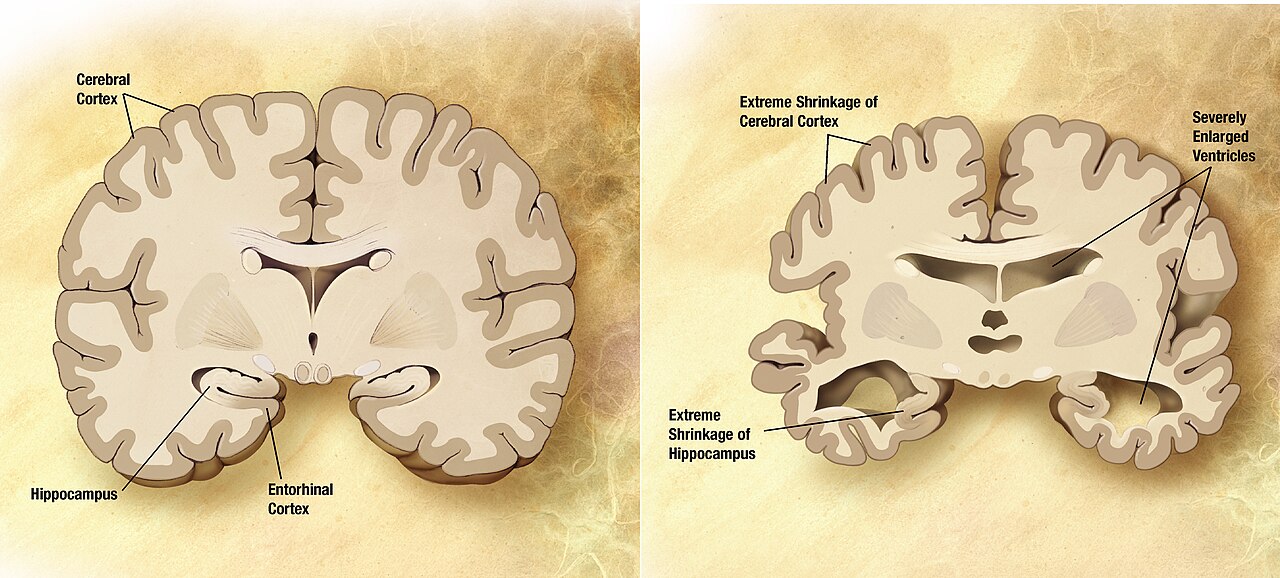 Image: National Institute on Aging (ADEAR), public domain, Wikimedia Commons
01 07
Next: The Organelle
Meet the lysosome, the cell's recycling center

01 / The disorder
Alzheimer's disease
Malfunctioning organelle: the lysosome (with the mitochondria hit next).
Alzheimer's is the most common cause of dementia, behind about 60-80% of cases. Dementia means memory and thinking loss bad enough to get in the way of daily life.
Neurons (brain cells) stop working, lose their connections and die. Two kinds of junk protein build up: beta-amyloid plaques between cells and tau tangles inside them.
It's named after Dr. Alois Alzheimer, who found those plaques and tangles in a patient's brain in 1906.
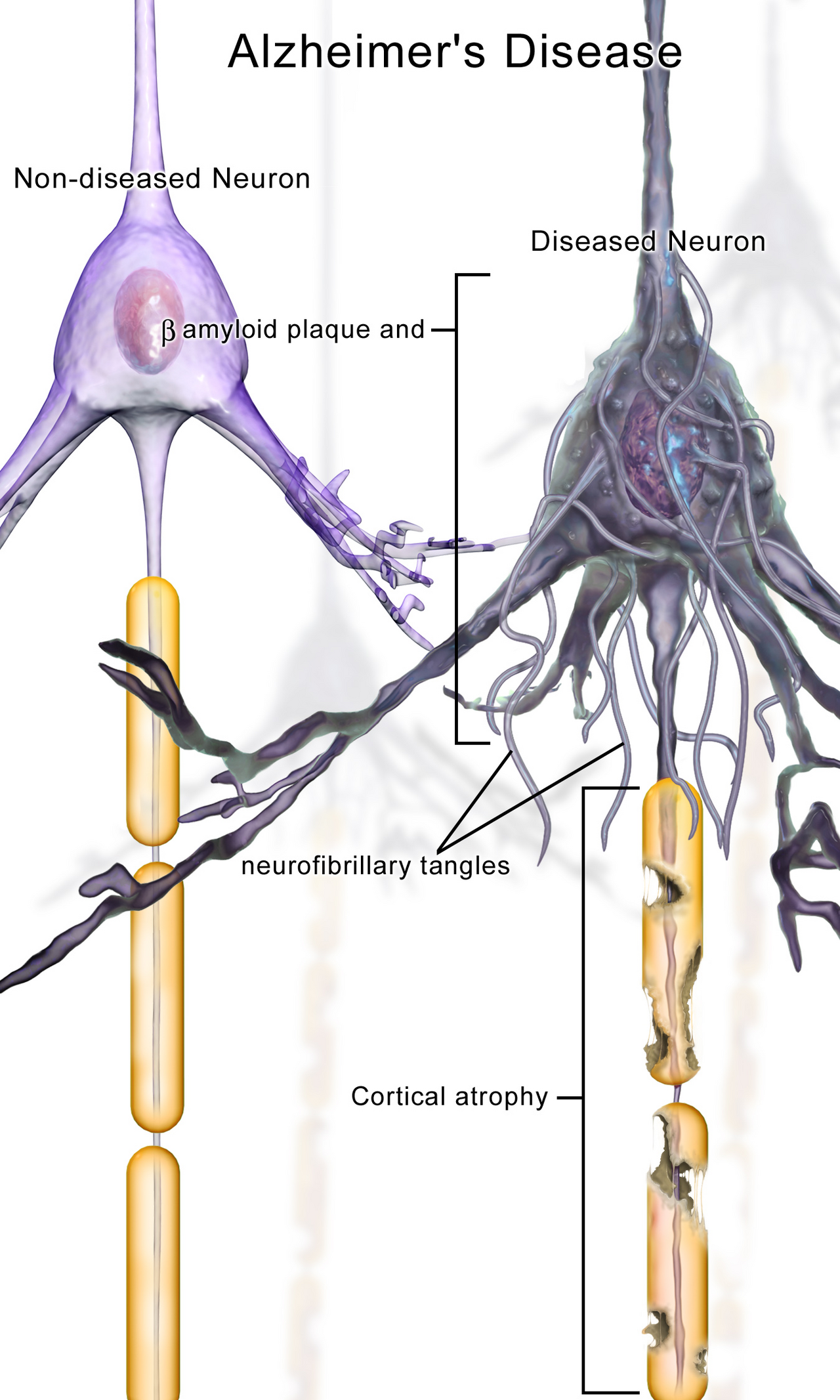
Image: BruceBlaus (Blausen Medical), CC BY 3.0, Wikimedia Commons

02 / Who it affects
Who gets it
Age is the biggest risk, but Alzheimer's is not a normal part of getting old. Full numbers are on the Statistics tab.
03 / The big idea
A cleanup system that broke
Every cell has a lysosome: a tiny acid-filled bubble that breaks down old parts and junk. Brain cells never get replaced, so they need their lysosomes working for a whole lifetime.
A 2022 study found that in Alzheimer's, lysosomes in neurons lose their acid. Junk protein piles up inside them, and the neuron dies and leaves behind a plaque.
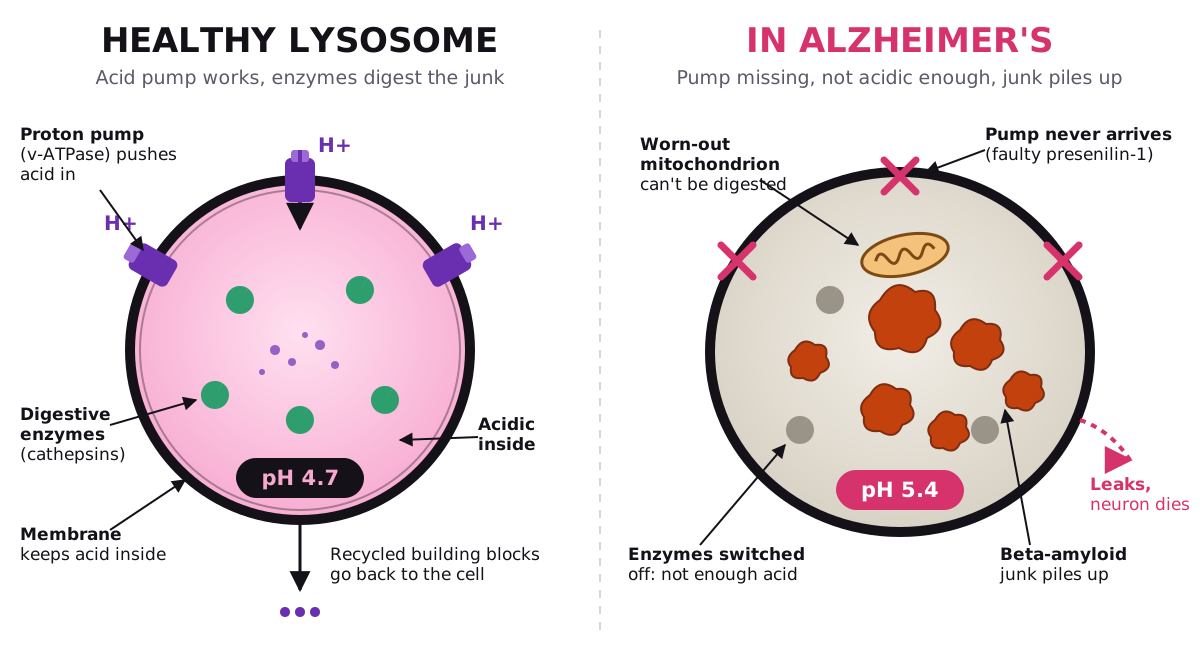
Image: Diagram made for this project, based on Lee et al. 2010 (Cell) and Nixon & Rubinsztein 2024
Sources for this tab
- Alzheimer's Association. What Is Alzheimer's Disease? https://www.alz.org/alzheimers-dementia/what-is-alzheimers
- National Institute on Aging. What Happens to the Brain in Alzheimer's Disease? https://www.nia.nih.gov/health/alzheimers-causes-and-risk-factors/what-happens-brain-alzheimers-disease
- National Institute on Aging. Alzheimer's Disease Fact Sheet. https://www.nia.nih.gov/health/alzheimers-and-dementia/alzheimers-disease-fact-sheet
- Alzheimer's Association. 2026 Alzheimer's Disease Facts and Figures (Alzheimer's & Dementia, 2026). https://pmc.ncbi.nlm.nih.gov/articles/PMC13098189/
- Lee JH, Yang DS, Goulbourne CN, et al., Nixon RA (2022). Faulty autolysosome acidification in Alzheimer's disease mouse models induces autophagic build-up of Aβ in neurons, yielding senile plaques. Nature Neuroscience 25:688-701. https://pmc.ncbi.nlm.nih.gov/articles/PMC9174056